
This post contains affiliate links, many which go to Amazon and are Geo-Affiliate links to nearest Amazon store.

Many of our readers keep sending us the same question: “Which is better, a portable power station or a classic gasoline generator?” As technology experts, we feel it is important to publish an article that clears up these doubts.
We always say that before making a decision, it is essential to analyze the type of use you are looking for, because that is what will determine which option suits you best. But do not worry, that is why we are here. We will help you understand the main differences between a portable power station and a traditional gasoline generator.
Which one offers more power?
A gasoline generator offers much higher maximum power per dollar invested than a portable power station. For continuous use, especially with high consumption equipment, a gasoline generator will almost always be the better option.
The biggest drawback of gasoline generators is that most of them are very heavy and, worse yet, extremely noisy. So if your goal is to get high power without damaging your own hearing or disturbing others, you can rule out gasoline generators altogether.
Portable power stations offer very good power, but they are more expensive when compared to gasoline generators. However, you get high quality electrical output with an incredibly low noise level. This means that even at night or while camping, you can use a portable power station without disturbing the peace of those around you.
Which one has a longer lifespan?
Both can last for many years, but the key difference is that a gasoline generator requires more maintenance due to its mechanical parts. If maintenance is neglected, it can fail severely and even become unusable.
Portable power stations, especially those that use LiFePO₄ battery cells (lithium iron phosphate), require almost no maintenance and can easily last more than 10 years, or thousands of charge cycles, while still retaining close to 80 percent of their original capacity.
Which one is safer?
Something many people do not realize is that gasoline generators should never be used indoors, since they produce carbon monoxide, a very dangerous gas that can be deadly in enclosed spaces. They must only be used outdoors or in open areas. This is very different from portable power stations, which are safe for indoor use because they do not emit any gases.
So, which one should you choose?
For high consumption equipment used for several hours, such as air conditioners, power tools, welding machines, or water pumps, a gasoline generator is the most suitable option because it offers higher continuous power and better performance for the price.
For everyday use, a portable power station is more practical and more than sufficient to power a refrigerator, TV, router, lights, smartphones, laptops, coffee makers, or fans. In addition, portable power stations can be recharged both from a wall outlet and from solar panels.
We are confident that after reading this, you will have a clearer idea of which option works best for you. Below, we recommend two popular choices: one gasoline generator and one medium to high power portable power station.
1. AMERISUN Portable Gas Inverter Generator

If you are looking for solid power without spending too much, for around $250 you can get the AMERISUN portable gas inverter generator. It offers a maximum output of 2500W, two 120V AC outlets, one 12V DC output, and two USB ports. This provides enough power to keep multiple devices running at the same time.
With a 1.05 gallon fuel tank, this generator can run for up to 11 hours at 25 percent load or 5.5 hours at 50 percent load. This gives you a good idea of how much gasoline you would need to keep it operating.
2. Jackery Explorer 2000 v2
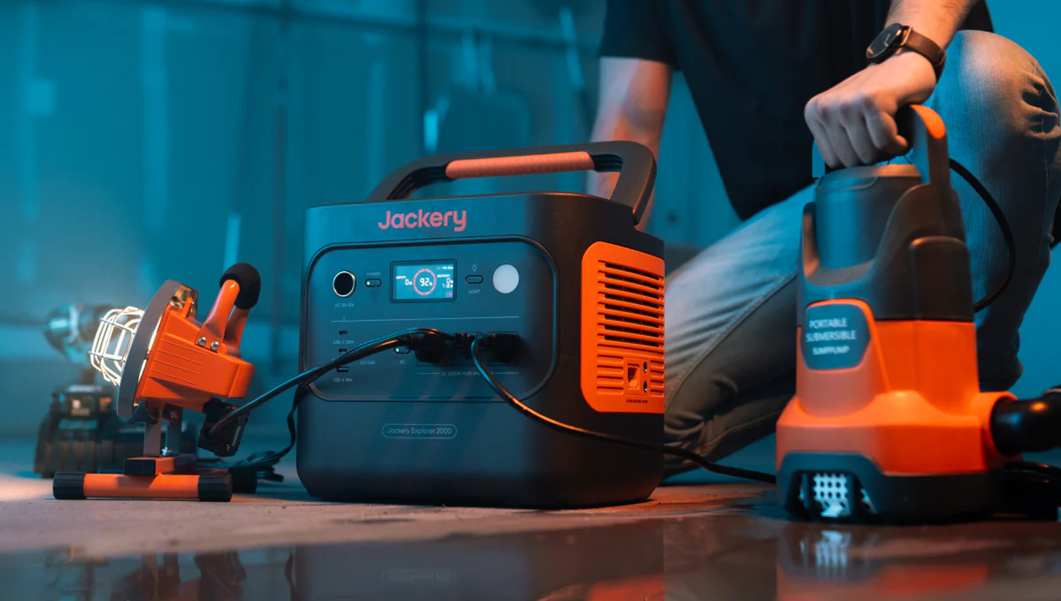
On the other hand, we have the powerful and popular Jackery Explorer 2000 v2, a portable power station that delivers 2200W of output power, with a surge capacity of up to 4400W. It features a 2042 Wh battery, which is an incredibly high capacity. To give you an idea, you could keep a 200W refrigerator running for up to 26 hours on a single charge.
It can be charged in about an hour and a half from a wall outlet, and it can also be paired with solar panels for solar charging, which would take around 5 hours.
It also comes with a 5 year warranty.