
This post contains affiliate links, many which go to Amazon and are Geo-Affiliate links to nearest Amazon store.

A few years ago, gas-powered generators were extremely popular, but as you probably already know, they have been almost replaced by portable power stations. The reason is simple: portable power stations are quiet, can be recharged using solar energy, and there are already models that offer high power output.
So, choosing a gas-powered generator may seem like it doesn't make much sense anymore, but if you ask me, they haven't been completely ruled out. Despite all the technological improvements, gas-powered generators still offer a high maximum power output for the price when compared to portable power stations.
You can get more power from a gas-powered generator, but the trade-off is increased noise and the fact that you practically cannot use one indoors. Gas-powered generators can cause carbon monoxide to build up in enclosed spaces, making them extremely dangerous.
Therefore, portable power stations are more environmentally friendly, safer, and, in the long run, more durable because they require practically no maintenance. In addition, some models use rechargeable LiFePO4 batteries that can last for more than 10 years or the equivalent of thousands of charging cycles.
Which portable power station should you choose?
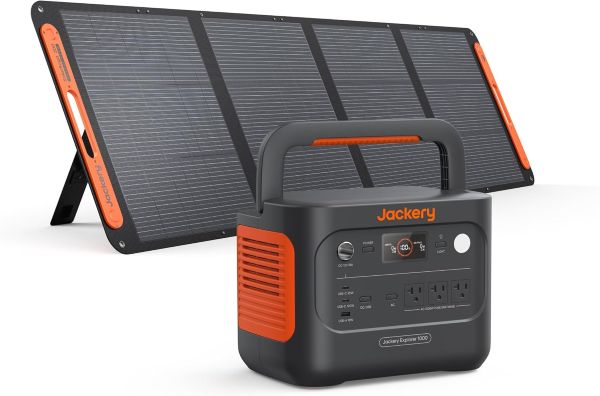
If you prefer to avoid dealing with gasoline, high noise levels, maintenance, and safety concerns, a great option to consider is the Jackery 1000 v2 solar generator. It is a fairly complete package because, in addition to the portable power station, it includes a solar panel, so you can also recharge it for free using solar energy.
It offers a maximum output of 1,500 W, with peak power of up to 3,000 W, so you can keep multiple devices and some appliances powered and charged, as long as their total power consumption does not exceed the 1,500 W maximum output.
Just to give you an idea, with this portable power station, you could easily keep a Starlink Mini running, which consumes between 25 W and 40 W, while still having enough power left to charge phones, laptops, drones, and much more.
The 1,070 Wh LiFePO4 rechargeable battery has a lifespan of more than 4,000 charging cycles, and even after that, it can still retain around 70% of its original capacity. The 1,070 Wh capacity can provide approximately 60 phone charges, 35 iPad charges, 20 MacBook Air charges, or up to 54 hours of runtime for a Starlink Mini.
It can be fully charged from a wall outlet in around 1 hour, although you can also use the included 200 W solar panel to charge it to 80% in about 6 hours. Solar charging time can be reduced to just 3 hours if you add two additional 200 W solar panels in the future, allowing you to fully charge the power station in less time.
Where can you buy it? Available here on Amazon